Industrial IoT Platform: A Complete Guide to Connected Industrial Operations
Industrial businesses increasingly rely on connected equipment, real-time data, and automated processes to improve how their facilities operate. An Industrial IoT (IIoT) platform provides the technology foundation for collecting data from industrial machines, connecting different systems, analyzing operational information, and supporting better decision-making.
From manufacturing plants and energy facilities to logistics operations and commercial infrastructure, IIoT platforms can help organizations understand equipment performance and operational conditions through connected data.
This guide explains what an industrial IoT platform is, how it works, its major components, benefits, applications, security considerations, and factors businesses should evaluate before selecting a platform.
What Is an Industrial IoT Platform?
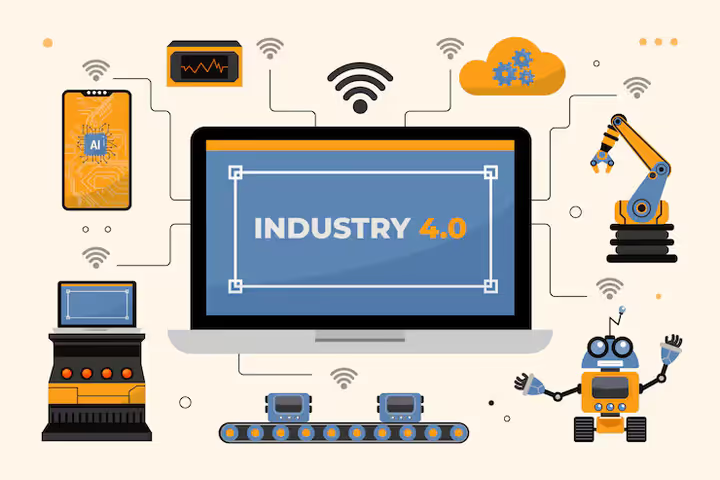
An Industrial IoT platform is a software environment that connects industrial equipment, sensors, machines, applications, and data sources. It collects information from connected devices and makes that information available for monitoring, analysis, visualization, and automation.
Unlike consumer IoT systems, industrial IoT platforms are designed for environments where reliability, security, scalability, and operational continuity are particularly important.
A typical platform may connect:
- Industrial machines
- Sensors and controllers
- Production equipment
- Building management systems
- Energy meters
- Enterprise applications
- Maintenance systems
- Cloud services
- Edge computing devices
The platform acts as a bridge between physical industrial assets and digital business systems.
Why Are Industrial IoT Platforms Important?
Industrial operations can generate enormous amounts of information every day. Temperature, vibration, pressure, energy consumption, production output, machine status, and maintenance events are examples of data that can be collected from connected equipment.
Without an appropriate software layer, this information can remain isolated across different machines and systems.
An IIoT platform can bring these data sources together and provide a more centralized view of operations.
Improving Operational Visibility
Real-time dashboards can help operations teams understand what is happening across equipment and facilities.
Instead of relying entirely on manual inspections or separate machine interfaces, organizations can use centralized monitoring tools to view relevant operational information.
Supporting Data-Driven Decisions
Industrial data can provide useful insights into equipment behavior, production processes, and resource consumption.
When properly analyzed, this information can support maintenance planning, operational improvements, and resource management.
Connecting Existing Systems
Many industrial facilities use equipment from different manufacturers. An IIoT platform can help integrate data from multiple technologies using appropriate industrial communication protocols and application interfaces.
How Does an Industrial IoT Platform Work?
An IIoT platform generally operates through several interconnected layers.
1. Data Collection
Sensors and industrial equipment generate operational data.
Examples include:
- Temperature
- Pressure
- Vibration
- Machine speed
- Energy consumption
- Equipment status
- Production measurements
Data may be collected from new sensors or existing industrial control systems.
2. Connectivity
The collected information needs to move securely between devices, edge systems, industrial networks, and applications.
Depending on the environment, technologies and protocols can include industrial Ethernet, MQTT, OPC UA, Modbus, cellular networks, Wi-Fi, and other communication technologies.
3. Edge Processing
Some industrial applications process information close to the equipment rather than sending every piece of data to a remote cloud environment.
Edge computing can be useful when an application requires rapid response, local processing, bandwidth optimization, or continued operation during intermittent connectivity.
4. Data Storage
IIoT platforms can store operational data for historical analysis, reporting, visualization, and other applications.
Depending on requirements, data may be stored locally, in private infrastructure, in cloud environments, or through hybrid architectures.
5. Analytics
Analytics tools can identify patterns and relationships within industrial data.
Organizations may use statistical analysis, rules-based monitoring, machine learning, or other analytical methods to investigate operational conditions.
6. Visualization
Dashboards transform raw industrial data into information that operators, engineers, maintenance teams, and managers can understand.
Common dashboard elements include:
- Equipment status
- Production metrics
- Energy consumption
- Alerts
- Historical trends
- Maintenance indicators
- Key performance indicators
Key Features of an Industrial IoT Platform
Different IIoT platforms provide different capabilities, but several features are commonly important.
Device Management
Device management allows organizations to register, configure, monitor, and maintain connected devices.
Large industrial environments may contain thousands of sensors and machines, making centralized device management valuable for operational teams.
Real-Time Monitoring
Real-time monitoring provides visibility into current equipment and process conditions.
For example, an operations dashboard could display machine status, production information, temperature measurements, and active alerts.
Data Analytics
Analytics capabilities allow users to examine historical and real-time data.
Organizations can use these tools to identify trends, compare equipment performance, and investigate unusual operating conditions.
Predictive Maintenance
Predictive maintenance uses equipment data and analytical techniques to identify conditions that may indicate a developing equipment problem.
It is important to understand that predictive analytics does not guarantee that equipment will never fail. Instead, it can provide additional information that maintenance teams can consider when planning inspections or service activities.
Asset Performance Management
Asset performance management combines equipment information, operational data, maintenance information, and analytics to support asset-related decisions.
This can be particularly relevant for industries with expensive or mission-critical equipment.
Digital Twin Technology
Some IIoT platforms support digital twins, which are digital representations of physical assets, systems, or processes.
A digital twin can combine operational data with engineering and asset information to help teams analyze how a physical system behaves.
Industrial IoT Platform Applications
Industrial IoT technology can be applied across many industries.
Smart Manufacturing
Manufacturers can connect production equipment to collect information about machine utilization, production processes, downtime, and quality-related measurements.
This information can support factory monitoring and continuous improvement initiatives.
Energy Management
Industrial facilities often consume significant amounts of electricity, gas, water, or other resources.
IoT-based energy monitoring can help organizations understand consumption patterns and identify areas where energy use may be optimized.
Predictive Equipment Maintenance
Connected sensors can provide information about vibration, temperature, pressure, and other equipment conditions.
Maintenance teams can use this data alongside inspection records and equipment history to support maintenance planning.
Supply Chain and Logistics
IIoT technologies can provide visibility into vehicles, containers, warehouses, and other assets.
Connected tracking systems can help organizations understand asset location, environmental conditions, and operational events.
Oil and Gas Operations
Industrial connectivity can be used to monitor equipment and infrastructure across production, processing, storage, and distribution environments.
Because these operations can involve complex infrastructure, reliable connectivity and strong cybersecurity practices are important considerations.
Utilities
Electricity, water, and other utility organizations can use connected technologies to monitor infrastructure, consumption, equipment status, and service conditions.
Industrial IoT and Predictive Maintenance
One of the most discussed IIoT applications is predictive maintenance.
Traditional maintenance approaches may include:
Reactive maintenance: Equipment is repaired after a failure occurs.
Preventive maintenance: Equipment is serviced according to a predefined schedule.
Predictive maintenance: Equipment data is analyzed to identify indicators associated with potential equipment problems.
An IIoT platform can collect information from sensors and combine it with historical maintenance records.
For example, increasing vibration combined with temperature changes may indicate that an asset deserves further inspection. Maintenance professionals can then investigate the equipment and determine the appropriate action.
The effectiveness of predictive maintenance depends on data quality, sensor placement, analytical methods, equipment characteristics, and maintenance processes.
Industrial IoT Cybersecurity
Cybersecurity is a critical consideration when connecting industrial equipment to digital networks.
An IIoT deployment can introduce additional connections between operational technology (OT), information technology (IT), cloud systems, and external services.
Network Segmentation
Organizations can use network segmentation to separate systems according to their security and operational requirements.
This can help limit unnecessary communication between different parts of an industrial environment.
Identity and Access Management
Users and devices should receive appropriate access based on their responsibilities.
Strong authentication and carefully managed permissions can reduce the risk associated with unauthorized access.
Data Encryption
Encryption can help protect information while it is transmitted or stored.
The appropriate encryption approach depends on the platform architecture, regulatory requirements, network environment, and organizational security policies.
Device Security
Connected devices should be managed throughout their lifecycle.
Security practices can include secure configuration, software updates, credential management, vulnerability management, and asset inventory.
Security Monitoring
Organizations should monitor relevant systems for unusual activity and potential security events.
Industrial cybersecurity should be considered during system design rather than added only after deployment.
Cloud, Edge, and Hybrid IIoT Architectures
Industrial IoT platforms can use different deployment models.
Cloud-Based IIoT
Cloud platforms can provide scalable computing and storage resources.
They can be useful for organizations that need centralized analytics across multiple facilities or geographic locations.
Edge-Based IIoT
Edge computing processes data close to industrial equipment.
This approach can be useful where low latency, local decision-making, or limited network connectivity is important.
Hybrid IIoT
Hybrid architectures combine edge infrastructure with cloud or centralized systems.
For example, an industrial facility could process time-sensitive information locally while sending selected historical data to a cloud platform for broader analysis.
Benefits of Using an Industrial IoT Platform
A properly designed IIoT system can provide several potential benefits.
Better Equipment Visibility
Centralized monitoring can make equipment conditions easier to understand.
Improved Maintenance Planning
Operational data can provide additional information for maintenance teams when deciding when equipment should be inspected or serviced.
Operational Efficiency
Data analysis can help organizations identify bottlenecks, unnecessary resource consumption, and recurring operational issues.
Improved Energy Awareness
Connected meters and sensors can provide detailed information about energy consumption across machines, production lines, buildings, or facilities.
Centralized Reporting
Organizations can combine information from multiple assets and locations into standardized reports and dashboards.
Challenges of Industrial IoT Adoption
IIoT implementation can also introduce challenges.
Legacy Equipment
Older machines may not have modern connectivity capabilities.
Organizations may need gateways, retrofit sensors, protocol converters, or other technologies to connect legacy assets.
Data Quality
Poor-quality or incomplete data can reduce the usefulness of analytics.
Sensor calibration, data validation, consistent naming, and reliable collection processes are therefore important.
Integration Complexity
Industrial environments often contain equipment from multiple vendors.
Integrating these systems may require specialized knowledge of industrial protocols and existing IT and OT architectures.
Cybersecurity Risks
Connecting previously isolated equipment can change the organization's cybersecurity risk profile.
Security architecture should therefore be included in the planning process.
Skills and Training
Successful IIoT programs may require expertise in industrial engineering, networking, cybersecurity, data analytics, cloud technologies, and software development.
How to Choose an Industrial IoT Platform
Organizations should evaluate platforms based on their specific technical and operational requirements.
Connectivity Support
Check whether the platform supports the protocols, devices, gateways, and systems already used within the organization.
Scalability
Consider whether the platform can support additional machines, facilities, users, and data volumes as the organization grows.
Security Capabilities
Review authentication, authorization, encryption, logging, vulnerability management, device security, and other relevant security capabilities.
Analytics
Evaluate whether the platform provides the analytical tools needed for monitoring, reporting, anomaly detection, and predictive applications.
Integration
Consider compatibility with enterprise resource planning, computerized maintenance management, manufacturing execution, customer relationship management, and other business systems where relevant.
Total Cost of Ownership
The cost of an IIoT solution can include more than software licensing.
Organizations should consider:
- Hardware
- Sensors
- Connectivity
- Cloud infrastructure
- Integration
- Implementation
- Training
- Maintenance
- Cybersecurity
- Technical support
Evaluating total cost of ownership can provide a more realistic picture of the long-term investment.
Industrial IoT Platform vs Traditional Monitoring Systems
Traditional monitoring systems often focus on specific machines or processes.
An IIoT platform typically aims to connect multiple data sources and make information available across a broader operational environment.
For example, a traditional monitoring system may display information from one production line, while an IIoT architecture could combine information from several production lines, maintenance systems, energy meters, and enterprise applications.
The appropriate approach depends on the organization's requirements, existing infrastructure, and operational objectives.
Future Trends in Industrial IoT
The industrial IoT market continues to evolve as connectivity, computing, and analytics technologies develop.
Artificial Intelligence and Machine Learning
AI and machine learning can help analyze large volumes of industrial data.
Potential applications include anomaly detection, predictive maintenance, quality analysis, demand forecasting, and process optimization.
Private Industrial Networks
Private wireless networks can provide organizations with additional options for connecting industrial devices and facilities.
Edge AI
AI processing at the edge can allow some analytical workloads to operate closer to industrial equipment.
Digital Twins
Digital twins are expected to remain relevant for asset monitoring, simulation, engineering analysis, and operational optimization.
Greater IT and OT Integration
As industrial systems become increasingly connected, organizations are placing greater emphasis on integrating information technology and operational technology while maintaining appropriate security boundaries.
Frequently Asked Questions
What is an Industrial IoT platform?
An Industrial IoT platform is a software environment that connects industrial equipment, sensors, systems, and applications so organizations can collect, manage, analyze, and visualize operational data.
What is the difference between IoT and IIoT?
IoT generally refers to connected devices across many environments, including homes, businesses, and public infrastructure. IIoT specifically focuses on industrial applications such as manufacturing, energy, utilities, logistics, and industrial infrastructure.
Is an IIoT platform cloud-based?
It can be cloud-based, edge-based, on-premises, or hybrid. The appropriate architecture depends on factors such as latency, connectivity, security, data requirements, and existing infrastructure.
Can IIoT support predictive maintenance?
Yes. IIoT platforms can collect equipment data that may be analyzed to identify patterns associated with potential equipment issues. Predictive maintenance results depend on data quality, equipment characteristics, analytics, and implementation.
Is Industrial IoT secure?
Industrial IoT security depends on how the system is designed, deployed, maintained, and monitored. Security measures can include network segmentation, access control, encryption, secure device management, software updates, and security monitoring.
How much does an Industrial IoT platform cost?
There is no single standard price. Costs can vary significantly depending on the number of connected assets, sensors, software features, deployment model, integration requirements, data volume, and support requirements. Businesses should evaluate the complete total cost of ownership rather than focusing only on software licensing.
Conclusion
An Industrial IoT platform provides a digital foundation for connecting industrial equipment and turning operational data into useful information. By combining connectivity, device management, data storage, analytics, dashboards, and integration capabilities, IIoT platforms can support applications ranging from equipment monitoring and predictive maintenance to energy management and production analysis.
However, successful implementation requires more than installing software. Organizations should carefully evaluate connectivity, cybersecurity, data quality, integration, scalability, workforce skills, and total cost of ownership.
As industrial organizations continue adopting connected technologies, IIoT platforms are likely to remain an important part of modern digital transformation strategies.