Intermediate Goods Industries: Meaning, Facts , Types, Importance, and Economic Role
Intermediate goods industries play an important role in modern economies by producing materials, components, and semi-finished products that are used by other businesses to manufacture final goods and services. Although these products may not usually reach consumers directly, they form an essential link between raw materials and finished products.
From steel and industrial chemicals to electronic components, packaging materials, and machine parts, intermediate goods support a wide range of industries. Understanding this sector can help businesses, investors, policymakers, and students understand how modern supply chains and manufacturing systems operate.
What Are Intermediate Goods?
Intermediate goods are products that are purchased by businesses and used as inputs in the production of another product or service. They are generally not intended for direct final consumption.
For example, steel can be used to manufacture automobiles, construction equipment, appliances, and machinery. In this case, steel is an intermediate good because it becomes part of another product.
Other examples include:
- Industrial chemicals used in manufacturing
- Electronic components used in consumer electronics
- Glass used in automobile and construction products
- Textile fibers used to produce clothing
- Industrial packaging used for finished products
- Machine parts used in manufacturing equipment
- Processed metals used in engineering products
- Semiconductor components used in electronic devices
Intermediate goods are therefore an important connection between primary industries and final-product industries.
How Intermediate Goods Industries Work
The production process can generally be viewed as a chain:
Raw Materials → Intermediate Goods → Finished Products → Consumers
For example, iron ore may be processed into steel. Steel can then be purchased by an automobile manufacturer and transformed into vehicle components. The finished automobile is eventually sold to customers.
This interconnected production structure means that the performance of one industry can influence many other industries. A shortage of a critical component, for example, can slow production across an entire supply chain.
Major Types of Intermediate Goods Industries
1. Metals and Metal Components
Metals such as steel, aluminum, copper, and specialty alloys are widely used in construction, transportation, machinery, energy infrastructure, and manufacturing.
Metal-processing companies may produce sheets, wires, tubes, bars, castings, and other components that are later incorporated into finished products.
2. Chemical Industries
Industrial chemicals are important inputs for pharmaceuticals, agriculture, textiles, plastics, paints, food processing, electronics, and many other sectors.
Chemical manufacturers may produce basic chemicals, specialty chemicals, industrial solvents, polymers, and other materials used in downstream production.
3. Electronic Components
Electronic components are essential to modern manufacturing. Semiconductors, sensors, circuit boards, connectors, batteries, and other components are used in computers, smartphones, automobiles, industrial equipment, and communication systems.
The growth of digital technologies has increased the strategic importance of reliable electronic component supply chains.
4. Textile and Fiber Industries
Natural and synthetic fibers are used to manufacture clothing, household textiles, technical fabrics, automotive interiors, and industrial materials.
Fiber producers and textile manufacturers therefore serve as suppliers to many downstream industries rather than only selling directly to consumers.
5. Plastic and Polymer Industries
Plastics and polymers are used in packaging, medical products, electronics, construction materials, automotive components, appliances, and industrial equipment.
Manufacturers may supply pellets, sheets, films, molded components, and other materials to companies that produce finished goods.
6. Machinery and Industrial Components
Industrial machinery manufacturers often produce components that are incorporated into larger machines and production systems.
Examples include motors, pumps, gears, bearings, valves, hydraulic components, and precision parts.
These products can be critical to industrial automation, manufacturing efficiency, and infrastructure development.
Why Intermediate Goods Industries Matter
Intermediate goods industries are important because they support the production capacity of other sectors.
Supporting Manufacturing
Factories depend on a steady supply of components and materials. Reliable intermediate-goods suppliers help manufacturers maintain production schedules and product quality.
Strengthening Supply Chains
A strong intermediate-goods sector can reduce supply-chain disruptions by providing businesses with dependable sources of essential inputs.
Creating Industrial Employment
These industries require workers across engineering, manufacturing, quality control, logistics, research, maintenance, procurement, and business management.
Encouraging Innovation
Intermediate-goods manufacturers often invest in material science, production technology, automation, and quality improvement. Their innovations can improve products throughout the wider economy.
Supporting International Trade
Intermediate products are frequently traded across borders. A component may be manufactured in one country, assembled in another, and sold as part of a finished product in a third market.
This makes intermediate goods an important part of global trade and international supply chains.
Intermediate Goods vs. Capital Goods
Intermediate goods and capital goods are sometimes confused because both are purchased by businesses.
The key difference is their role in production.
Intermediate goods are generally consumed, transformed, or incorporated into another product during the production process.
Capital goods are durable assets such as industrial machinery, production equipment, and buildings that businesses use repeatedly to produce goods or services.
For example, steel used to manufacture a car is an intermediate input, while a robotic assembly machine used repeatedly in a car factory is a capital good.
Factors Affecting Intermediate Goods Industries
Several factors influence the performance of these industries.
Raw Material Prices
Changes in the prices of metals, energy, chemicals, agricultural inputs, and other raw materials can affect production costs.
Energy Costs
Many intermediate-goods industries are energy-intensive. Electricity and fuel prices can therefore have a significant effect on operating expenses and product prices.
Technology
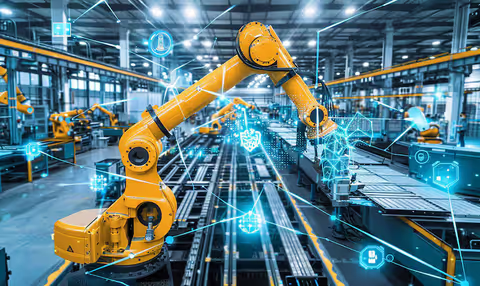
Automation, artificial intelligence, robotics, advanced manufacturing, and digital supply-chain systems are changing how intermediate goods are produced and distributed.
Trade Policies
Tariffs, import regulations, export controls, customs requirements, and international trade agreements can influence sourcing and production decisions.
Demand From Downstream Industries
Demand for intermediate products is closely linked to demand for finished products. When automobile, construction, electronics, or infrastructure production increases, demand for relevant intermediate inputs can also rise.
Recent Trends in Intermediate Goods Manufacturing
The intermediate-goods sector is undergoing significant changes as manufacturers respond to evolving technology and supply-chain requirements.
Supply-Chain Diversification
Businesses are increasingly examining supplier concentration and looking for ways to reduce dependence on a single country or supplier. Multi-source procurement and regional manufacturing strategies are becoming more common.
Automation and Smart Manufacturing
Industrial automation allows manufacturers to improve productivity, consistency, and production monitoring. Connected machines and industrial data systems can provide better visibility into manufacturing operations.
Sustainable Production
Companies are placing greater emphasis on energy efficiency, recycling, waste reduction, and responsible sourcing. Environmental requirements are also influencing material selection and production processes.
Advanced Materials
New materials with improved strength, durability, conductivity, heat resistance, or lightweight characteristics are creating opportunities across aerospace, automotive, electronics, construction, and energy industries.
Digital Procurement
Digital procurement platforms and supply-chain management software are helping companies compare suppliers, monitor inventory, manage purchasing processes, and improve visibility into costs.
Business and Investment Considerations
Companies operating in intermediate goods industries often need substantial investment in equipment, technology, quality systems, logistics, and workforce training.
Businesses evaluating this sector may consider factors such as:
- Manufacturing capacity
- Production costs
- Supplier reliability
- Inventory management
- Customer concentration
- Technology adoption
- Regulatory compliance
- Export opportunities
- Energy efficiency
- Working capital requirements
Financial planning is particularly important because manufacturers may need to purchase raw materials well before receiving payment for finished orders.
Businesses may also explore commercial financing, equipment financing, working capital solutions, and other financial services when expanding production capacity.
Challenges Facing Intermediate Goods Industries
Despite their importance, intermediate-goods industries face several challenges.
Supply-chain disruptions: Delays in transportation or shortages of critical materials can interrupt production.
Cost volatility: Energy, commodities, freight, and other input costs can change rapidly.
Quality requirements: Industrial customers often require consistent specifications and strict quality control.
Technology investment: Remaining competitive may require continuous investment in automation and advanced manufacturing systems.
Regulatory requirements: Environmental, safety, labor, and trade regulations can increase operational complexity.
Global competition: Manufacturers may compete with suppliers from multiple regions, making productivity and cost management important.
The Future of Intermediate Goods Industries
The future of intermediate goods manufacturing is likely to be shaped by automation, digitalization, advanced materials, sustainable production, and more resilient supply chains.
Manufacturers that can combine efficient production with reliable procurement, strong quality management, and technological innovation may be better positioned to serve changing downstream markets.
As industries such as electric mobility, renewable energy, electronics, data infrastructure, healthcare technology, and advanced manufacturing continue to develop, demand for specialized components and materials may create new opportunities for intermediate-goods suppliers.
Conclusion
Intermediate goods industries form one of the fundamental layers of the modern economy. They provide the materials, components, chemicals, parts, and semi-finished products required by manufacturers and service providers across numerous sectors.
Their importance extends beyond individual factories. A reliable intermediate-goods ecosystem can strengthen manufacturing, support employment, improve supply-chain resilience, encourage innovation, and contribute to international trade.
For businesses and investors, understanding intermediate goods can provide useful insight into manufacturing costs, supply-chain risks, industrial demand, and opportunities for long-term growth.