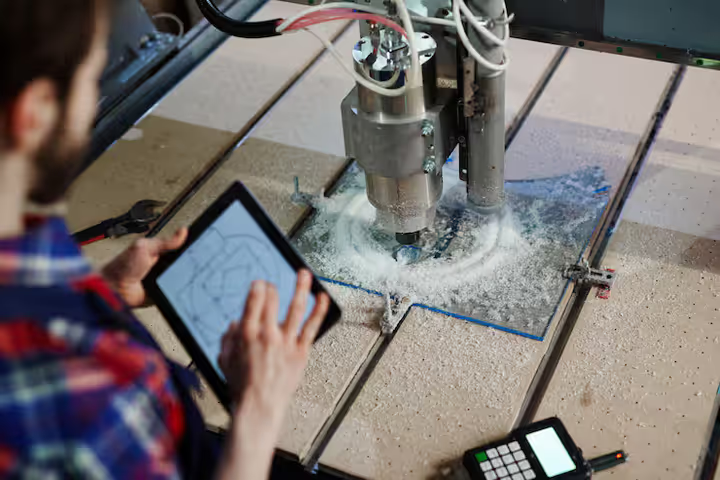
CNC Precision Engineering: A Complete Guide to Modern Manufacturing
CNC precision engineering is one of the most important technologies in modern manufacturing. It enables industries to produce highly accurate components with consistent quality and minimal human error. From aerospace parts and medical devices to automotive components and electronic equipment, CNC precision engineering plays a critical role in creating products that require exact measurements and reliable performance.
As manufacturing industries continue to embrace digital transformation, CNC technology has become a foundation for advanced production processes. Understanding how CNC precision engineering works, why it matters, and how it continues to evolve can help businesses, students, and industry professionals better appreciate its significance in today's industrial landscape.
Understanding CNC Precision Engineering
CNC stands for Computer Numerical Control. CNC precision engineering refers to the process of using computer-controlled machines to manufacture parts and components with extremely tight tolerances and high accuracy.
Unlike traditional manual machining, CNC systems follow programmed instructions that guide cutting tools, drills, mills, and lathes. These machines can repeatedly create identical parts with minimal variation.
Common CNC processes include:
- CNC milling
- CNC turning
- CNC drilling
- CNC grinding
- CNC electrical discharge machining (EDM)
- Multi-axis machining
The technology exists because manufacturers require consistent, repeatable, and accurate production methods that can meet increasingly complex design requirements.
How CNC Precision Engineering Works
The CNC manufacturing process typically follows several stages:
| Stage | Description |
|---|---|
| Design | Engineers create a digital model using CAD software |
| Programming | CAM software converts designs into machine instructions |
| Setup | Materials and tools are prepared |
| Machining | CNC equipment performs cutting and shaping operations |
| Inspection | Quality checks verify dimensional accuracy |
| Final Processing | Finishing, polishing, or coating may be applied |
The entire workflow is designed to reduce production errors and improve manufacturing efficiency.
Why CNC Precision Engineering Matters Today
Modern industries demand components that meet strict performance and safety requirements. CNC precision engineering helps achieve these goals through automated and highly accurate manufacturing processes.
Several factors have increased its importance:
- Growing demand for complex product designs
- Expansion of automation technologies
- Higher quality standards across industries
- Need for consistent mass production
- Increased focus on manufacturing efficiency
Industries Influenced by CNC Precision Engineering
Many sectors depend heavily on precision manufacturing.
| Industry | Typical Applications |
| Aerospace | Engine components, structural parts |
| Automotive | Transmission systems, brake components |
| Medical | Surgical instruments, implants |
| Electronics | Connectors, housings, circuit components |
| Energy | Turbine parts, industrial equipment |
| Robotics | Precision mechanical assemblies |
The ability to manufacture highly detailed components makes CNC engineering essential across these industries.
Problems Solved by CNC Technology
Before CNC systems became widely available, manufacturers faced numerous production challenges.
Key problems addressed by CNC precision engineering include:
- Inconsistent product quality
- Human measurement errors
- Slow production cycles
- Limited design complexity
- Excessive material waste
- Difficulties in scaling production
By automating machining operations, CNC systems significantly improve repeatability and production reliability.
Manufacturing Efficiency Comparison
The table below illustrates general improvements associated with CNC manufacturing compared to traditional machining methods.
| Manufacturing Factor | Traditional Machining | CNC Precision Engineering |
| Accuracy | Moderate | Very High |
| Repeatability | Variable | Consistent |
| Production Speed | Moderate | High |
| Complex Designs | Limited | Extensive |
| Human Intervention | High | Lower |
| Material Utilization | Moderate | Improved |
Recent Trends and Industry Developments
The CNC precision engineering sector has experienced notable advancements during 2025 and 2026.
Artificial Intelligence Integration
Many manufacturers are integrating artificial intelligence into CNC operations. AI-driven systems can analyze machine performance, predict maintenance requirements, and optimize machining parameters.
This trend gained momentum throughout 2025 as manufacturers sought to improve productivity and reduce downtime.
Digital Twin Technology
Digital twins have become increasingly important in manufacturing environments.
A digital twin is a virtual representation of a physical machine or production system. Engineers can simulate machining processes before actual production begins, helping identify potential issues and improve efficiency.
Smart Manufacturing Expansion
Industry 4.0 initiatives continue to influence CNC precision engineering.
Modern CNC machines increasingly feature:
- Real-time monitoring
- Cloud connectivity
- Automated quality inspection
- Data analytics integration
- Remote performance tracking
Multi-Axis Machining Growth
Five-axis and advanced multi-axis machining systems have become more common across manufacturing facilities.
Benefits include:
- Greater design flexibility
- Reduced setup time
- Improved surface finishes
- Enhanced production accuracy
Sustainability Initiatives
Throughout 2025 and early 2026, many manufacturers focused on reducing environmental impact by:
- Improving energy efficiency
- Minimizing material waste
- Optimizing cutting strategies
- Recycling machining materials
CNC Technology Adoption Trend
Manufacturing Digitalization
2022: ██████
2023: ████████
2024: ██████████
2025: ████████████
2026: █████████████
The trend reflects the growing adoption of digital manufacturing technologies worldwide.
Regulations and Policy Considerations
CNC precision engineering operates within various regulatory frameworks depending on the country and industry.
Product Quality Standards
Manufacturers often follow internationally recognized standards such as:
- ISO 9001 Quality Management Systems
- ISO 13485 for medical device manufacturing
- AS9100 for aerospace manufacturing
These standards help ensure consistency and quality across production processes.
Workplace Safety Regulations
Manufacturing facilities must comply with workplace safety requirements that govern:
- Machine operation procedures
- Employee training
- Protective equipment
- Hazard management
- Emergency response planning
Safety compliance remains an important aspect of CNC operations.
Environmental Compliance
Many governments have introduced regulations related to:
- Industrial emissions
- Waste management
- Energy efficiency
- Resource conservation
Manufacturers increasingly use modern CNC systems to support sustainability objectives and regulatory compliance.
Digital Manufacturing Programs
Several countries have launched initiatives supporting advanced manufacturing technologies.
Examples include:
- Smart manufacturing programs
- Industry 4.0 frameworks
- Digital transformation initiatives
- Industrial innovation strategies
These programs encourage modernization and technological advancement within manufacturing sectors.
Useful Tools and Resources
A variety of software platforms and resources support CNC precision engineering activities.
CAD Software
Computer-Aided Design software helps engineers create digital models.
Popular options include:
- AutoCAD
- SolidWorks
- Fusion 360
- CATIA
CAM Software
Computer-Aided Manufacturing software converts designs into machining instructions.
Common examples include:
- Mastercam
- Fusion 360 CAM
- Edgecam
- PowerMill
CNC Simulation Tools
Simulation software allows engineers to test machining operations before production.
Examples include:
- Vericut
- NC Simul
- CAMplete
Quality Inspection Resources
Measurement and inspection tools include:
- Coordinate Measuring Machines (CMM)
- Digital calipers
- Laser scanners
- Optical inspection systems
Educational Resources
Professionals and students often use:
- Manufacturing engineering publications
- Technical standards organizations
- Industry association resources
- Engineering learning platforms
These resources help improve knowledge and understanding of CNC technology.
Frequently Asked Questions
What is CNC precision engineering?
CNC precision engineering is a manufacturing process that uses computer-controlled machinery to produce highly accurate parts and components according to programmed instructions.
Which industries use CNC precision engineering the most?
Aerospace, automotive, medical, electronics, robotics, and energy industries are among the largest users of CNC precision manufacturing technologies.
How accurate are CNC machines?
Modern CNC machines can achieve extremely tight tolerances, often measured in microns, depending on machine capabilities and manufacturing requirements.
What is the difference between CNC milling and CNC turning?
CNC milling uses rotating cutting tools to remove material from a stationary workpiece, while CNC turning rotates the workpiece against a stationary cutting tool.
How does CNC technology support manufacturing efficiency?
CNC systems improve efficiency through automation, repeatable production, reduced errors, optimized material usage, and faster production cycles.
Conclusion
CNC precision engineering has become a cornerstone of modern manufacturing. By combining computer control, advanced machinery, and sophisticated software, it enables the production of highly accurate components used across numerous industries.
The growing adoption of artificial intelligence, digital twins, smart manufacturing systems, and sustainability initiatives continues to shape the future of CNC technology. At the same time, quality standards, safety regulations, and environmental policies ensure that manufacturing operations remain reliable and responsible.
As industries continue to pursue greater efficiency, accuracy, and innovation, CNC precision engineering will remain a vital technology supporting the next generation of manufacturing advancements.