Industrial Ice Cream Manufacturing Unit: Process, Equipment, Cost, Facts and Quality Standards
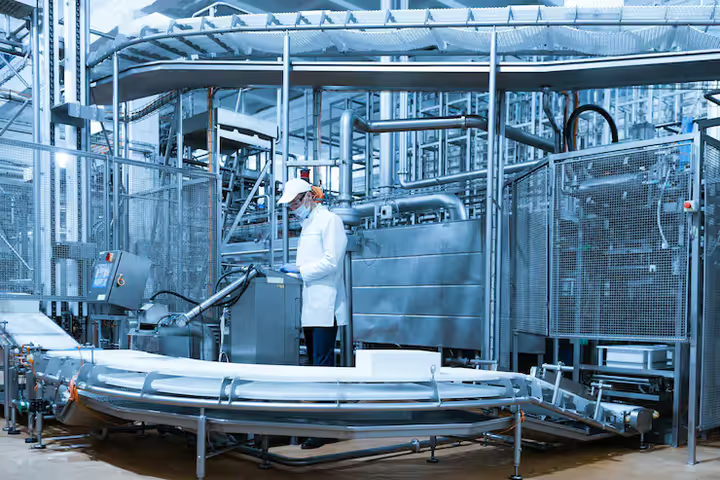
Ice cream is one of the most widely consumed frozen desserts, but producing it on an industrial scale involves much more than mixing milk, sugar, and flavoring. A modern industrial ice cream manufacturing unit combines food processing technology, refrigeration, automation, quality control, packaging, and cold-chain management to produce consistent products in large quantities.
Commercial manufacturers typically use specialized equipment to control ingredients, temperature, texture, overrun, freezing conditions, and packaging. The exact production setup depends on the product range, production capacity, packaging format, and applicable food-safety requirements.
This guide explains how an industrial ice cream manufacturing unit operates, what equipment is commonly required, how the manufacturing process works, and what factors influence the overall investment.
What Is an Industrial Ice Cream Manufacturing Unit?
An industrial ice cream manufacturing unit is a production facility designed to manufacture frozen dairy or non-dairy desserts at commercial scale.
Unlike small-batch production, an industrial facility uses integrated processing systems that can handle large quantities of ingredients while maintaining controlled operating conditions.
A typical facility may include:
- Raw-material storage
- Ingredient weighing and dosing systems
- Mixing tanks
- Pasteurization equipment
- Homogenization systems
- Aging tanks
- Continuous freezers
- Flavor and inclusions systems
- Filling and packaging machines
- Cold storage
- Industrial refrigeration
- Quality-control laboratories
- Cleaning and sanitation systems
Automation can also be incorporated to monitor temperature, flow rate, pressure, production volumes, and other process parameters.
Why Industrial Ice Cream Production Matters
The demand for frozen desserts has encouraged manufacturers to improve production efficiency while maintaining product quality.
An industrial production line can provide several advantages:
Consistent Product Quality
Automated processing helps manufacturers maintain repeatable formulations and processing conditions. Consistency is particularly important when products are distributed across multiple locations.
Higher Production Capacity
Industrial equipment allows manufacturers to process substantially larger quantities than manual or small-scale systems.
Improved Process Control
Modern food processing equipment can monitor critical parameters such as temperature, pressure, mixing speed, and freezing conditions.
Better Production Efficiency
Automation can reduce repetitive manual operations and improve the utilization of labor, ingredients, utilities, and production equipment.
Packaging Flexibility
Depending on the production line, manufacturers can produce different formats, including cups, tubs, cones, sticks, sandwiches, and multipacks.
Industrial Ice Cream Manufacturing Process
The industrial ice cream manufacturing process consists of several controlled stages.
1. Ingredient Selection and Preparation
The first stage involves selecting and preparing the ingredients.
Common ingredients include:
- Milk or milk solids
- Cream
- Sugar
- Stabilizers
- Emulsifiers
- Water
- Flavoring ingredients
- Cocoa or chocolate ingredients
- Fruit preparations
- Nuts and other inclusions
Manufacturers formulate the recipe according to the desired nutritional profile, texture, flavor, and product specifications.
Accurate ingredient measurement is essential because small variations can affect the finished product.
2. Mixing
The selected ingredients are transferred into industrial mixing tanks.
The objective is to create a uniform mixture in which the ingredients are properly dispersed.
High-quality industrial mixing equipment may use controlled agitation and temperature management to improve the consistency of the mix.
For larger facilities, automated ingredient dosing can help reduce measurement errors and improve production repeatability.
3. Pasteurization
Pasteurization is an important food-safety step in many ice cream production systems.
The ice cream mix is heated according to an appropriate validated process to reduce harmful microorganisms.
Industrial pasteurization equipment typically provides controlled temperature and holding conditions. The precise parameters depend on the formulation, equipment design, applicable regulations, and manufacturer's validated process.
Effective process control is essential because both insufficient treatment and inappropriate heating can create quality or safety problems.
4. Homogenization
After or during heat treatment, the mixture may undergo homogenization.
A commercial homogenizer reduces the size of fat globules and helps create a more uniform mixture.
Proper homogenization can contribute to:
- Improved texture
- Better fat distribution
- Greater product stability
- Smoother mouthfeel
Homogenization conditions are selected according to the formulation and desired product characteristics.
5. Aging of the Mix
The processed mix is cooled and held in aging tanks.
During this stage, certain components of the formulation undergo physical changes that help prepare the mixture for freezing.
Industrial aging tanks generally include:
- Temperature control
- Agitation
- Insulated construction
- Hygienic product-contact surfaces
The holding time and temperature are determined by the formulation and manufacturing process.
6. Flavor and Ingredient Addition
At this point, manufacturers can introduce selected flavors and ingredients.
Examples include:
- Vanilla
- Chocolate
- Strawberry
- Mango
- Coffee
- Caramel
- Cookies
- Nuts
- Fruit pieces
- Chocolate chips
Automated dosing systems can improve consistency when adding flavorings, sauces, or inclusions.
7. Continuous Freezing
Freezing is one of the most important stages in commercial ice cream manufacturing.
A continuous ice cream freezer rapidly freezes the mix while incorporating controlled amounts of air.
The air incorporated into the product is commonly described as overrun. The appropriate level depends on the product style and formulation.
The freezing process influences:
- Ice-crystal formation
- Texture
- Density
- Stability
- Product consistency
Modern industrial freezers are designed to maintain controlled operating conditions throughout production.
8. Filling and Forming
After freezing, the semi-frozen product moves toward filling or forming equipment.
Depending on the product, the production line may fill:
- Cups
- Tubs
- Containers
- Cones
- Sandwiches
- Stick products
Automated filling equipment can control portion sizes and improve production speed.
9. Hardening
Freshly frozen ice cream normally requires further hardening before long-term storage.
Industrial hardening systems rapidly reduce product temperature so that the remaining water freezes and the desired product structure develops.
Rapid and controlled hardening can help limit the formation of larger ice crystals and preserve product quality.
10. Cold Storage and Distribution
Finished products are transferred to frozen storage before distribution.
An industrial facility may require:
- Walk-in cold rooms
- Blast freezers
- Refrigeration compressors
- Temperature monitoring systems
- Insulated storage areas
- Refrigerated transportation
Maintaining the cold chain is essential because repeated temperature fluctuations can negatively affect frozen-product quality.
Major Equipment Used in an Industrial Ice Cream Manufacturing Unit
A commercial ice cream factory may require a combination of processing, refrigeration, packaging, and utility equipment.
| Equipment | Main Function |
|---|---|
| Mixing tank | Combines ingredients |
| Pasteurizer | Provides controlled heat treatment |
| Homogenizer | Creates a more uniform emulsion |
| Aging tank | Holds and conditions the mix |
| Continuous freezer | Freezes mix and incorporates air |
| Flavor dosing system | Adds flavors and ingredients |
| Filling machine | Fills containers or molds |
| Hardening freezer | Rapidly hardens finished products |
| Cold storage system | Stores frozen products |
| Refrigeration system | Provides cooling capacity |
| CIP system | Supports automated cleaning |
| Packaging machine | Seals and prepares products for distribution |
The final equipment configuration should be based on the planned capacity, product types, facility layout, utilities, labor model, and regulatory requirements.
Industrial Refrigeration System
Refrigeration is a major part of an industrial ice cream facility.
Cooling is required during multiple stages, including mix processing, aging, freezing, hardening, and storage.
A typical industrial refrigeration system can include:
- Compressors
- Condensers
- Evaporators
- Pumps
- Refrigerant controls
- Heat exchangers
- Temperature sensors
- Automated control systems
Energy consumption can represent a significant operating consideration for frozen-food manufacturers. Therefore, equipment efficiency, insulation, maintenance, heat recovery opportunities, and appropriate refrigeration-system design can influence long-term operating costs.
Food Safety and Quality Control
Food safety should be incorporated into the design and operation of an ice cream manufacturing facility.
A professional quality-control program may include controls for:
Raw Materials
Ingredients should be received, identified, stored, and inspected according to established specifications.
Temperature
Temperature monitoring is important throughout processing, storage, and distribution.
Microbiological Testing
Depending on the product and applicable regulations, manufacturers may conduct microbiological testing of ingredients, processing environments, and finished products.
Allergen Management
Ice cream may contain or come into contact with allergens such as milk, nuts, peanuts, soy, wheat, or other ingredients.
Manufacturers should establish appropriate allergen-control procedures.
Sanitation
Production equipment must be cleaned and sanitized according to validated procedures.
CIP Systems in Ice Cream Manufacturing
Clean-in-place (CIP) systems allow certain processing equipment and pipelines to be cleaned without completely dismantling them.
A CIP system can automate stages such as:
- Pre-rinsing
- Cleaning
- Intermediate rinsing
- Sanitization
- Final rinsing where applicable
Proper CIP design is especially important for dairy and frozen-food processing because product residues can support microbial growth if cleaning is inadequate.
Automation in Ice Cream Manufacturing
Automation is increasingly important in modern food manufacturing.
A computerized control system can monitor production parameters and provide information about equipment performance.
Automation may be used for:
- Ingredient dosing
- Temperature control
- Mixing
- Pasteurization
- Freezing
- Filling
- Packaging
- Refrigeration
- Production monitoring
- Quality records
Sensors and programmable control systems can help manufacturers identify deviations before they become significant production problems.
Energy Efficiency in an Ice Cream Factory
Because ice cream production involves refrigeration and freezing, energy management is an important business consideration.
Manufacturers can investigate several approaches to improve energy efficiency:
Efficient Refrigeration Equipment
Modern refrigeration equipment can reduce energy consumption when correctly sized and maintained.
Thermal Insulation
Well-insulated pipes, tanks, cold rooms, and freezer areas can reduce unwanted heat transfer.
Preventive Maintenance
Poorly maintained compressors, condensers, pumps, and heat exchangers may operate less efficiently.
Heat Recovery
Some industrial refrigeration and processing systems may provide opportunities for heat recovery, depending on facility design.
Automated Monitoring
Energy-monitoring systems can help identify unusual consumption and equipment-performance issues.
Industrial Ice Cream Manufacturing Unit Cost
The cost of an industrial ice cream manufacturing unit varies considerably because there is no single standard factory configuration.
Major investment factors include:
- Production capacity
- Number of production lines
- Product types
- Degree of automation
- Freezing capacity
- Packaging technology
- Refrigeration capacity
- Building requirements
- Cold-storage capacity
- Utility infrastructure
- Laboratory equipment
- Installation costs
- Local regulations
A small commercial production facility may require substantially less investment than a highly automated factory producing multiple product categories.
For an accurate capital expenditure estimate, manufacturers normally request quotations based on a detailed production specification rather than relying on a generic equipment price.
Operating Costs of an Ice Cream Manufacturing Business
Capital investment is only one part of the financial picture.
Ongoing operating expenses can include:
- Milk and dairy ingredients
- Sugar and sweeteners
- Flavors
- Packaging materials
- Electricity
- Water
- Refrigeration
- Labor
- Equipment maintenance
- Cleaning chemicals
- Quality testing
- Warehouse expenses
- Transportation
- Insurance
- Waste management
A financial model should separate fixed costs from variable costs and evaluate production utilization before estimating profitability.
Choosing Industrial Ice Cream Production Equipment
Selecting the right food manufacturing equipment requires more than comparing purchase prices.
Important considerations include:
Production Capacity
Determine the expected hourly and daily production volume.
Product Range
A plant producing only packaged tubs may require different equipment from a facility producing cones, sticks, sandwiches, and premium products.
Automation Level
Automation can reduce repetitive labor requirements but generally increases initial capital expenditure.
Hygienic Design
Equipment should be designed for food processing and allow effective cleaning and inspection.
Energy Consumption
Compare the expected energy requirements of different equipment configurations.
Spare Parts and Technical Support
Availability of maintenance support and replacement components can influence long-term production reliability.
Industrial Ice Cream Packaging
Packaging protects the product while also providing information to consumers.
Common packaging formats include:
- Plastic cups
- Paperboard containers
- Tubs
- Wrappers
- Multipacks
- Composite containers
Packaging machinery may perform several functions, including filling, sealing, coding, labeling, and secondary packing.
Manufacturers must ensure that packaging materials and labeling comply with the applicable food regulations in the markets where products are sold.
Maintenance of Ice Cream Manufacturing Equipment
Preventive maintenance is important for minimizing unexpected production interruptions.
A maintenance program may include inspections of:
- Refrigeration compressors
- Pumps
- Valves
- Homogenizers
- Freezers
- Filling equipment
- Conveyors
- Sensors
- Control panels
- Sealing systems
Maintenance schedules should be based on equipment manufacturer recommendations, operating conditions, production hours, and historical equipment performance.
Sustainability Considerations
Ice cream factories can also examine environmental performance as part of long-term facility planning.
Potential areas for improvement include:
- Reducing food waste
- Improving refrigeration efficiency
- Reducing water consumption
- Optimizing cleaning cycles
- Recovering heat where practical
- Improving packaging efficiency
- Reducing unnecessary transportation
- Monitoring electricity consumption
Sustainability initiatives should be evaluated according to measurable energy, water, waste, and financial outcomes.
Frequently Asked Questions
How does an industrial ice cream factory work?
An industrial ice cream factory typically receives and prepares ingredients, mixes and heat-treats the formulation, homogenizes and ages the mix, freezes it, fills or forms the product, hardens it, packages it, and stores it under controlled frozen conditions.
What equipment is needed to manufacture ice cream commercially?
Common equipment includes mixing tanks, pasteurizers, homogenizers, aging tanks, continuous freezers, filling machines, hardening systems, packaging equipment, refrigeration systems, cold storage, and cleaning systems.
Is an industrial ice cream manufacturing unit expensive?
The investment depends on production capacity, automation, product variety, refrigeration requirements, packaging equipment, facility construction, and other factors. A detailed technical specification is required before obtaining a reliable project cost.
Why is refrigeration important in ice cream manufacturing?
Refrigeration is essential for cooling the mix, freezing the product, hardening finished ice cream, and maintaining frozen storage and distribution conditions.
What is overrun in ice cream?
Overrun refers to the increase in volume caused by incorporating air into the ice cream mix during freezing. The desired overrun depends on the formulation and product style.
Why is homogenization used?
Homogenization helps reduce fat-globule size and improve the uniformity and physical properties of the ice cream mix.
What is CIP in food manufacturing?
CIP means clean-in-place. It is a cleaning approach that allows suitable processing equipment and pipework to be cleaned using controlled cleaning cycles without complete dismantling.
Conclusion
An industrial ice cream manufacturing unit is a complex food-processing operation that combines ingredient handling, thermal processing, homogenization, aging, freezing, packaging, refrigeration, sanitation, and quality control.
The most important considerations when planning a facility are not simply the price of individual machines. Production capacity, product formulation, automation, refrigeration requirements, food safety, energy consumption, maintenance, packaging, and cold-chain management all influence the performance and economics of the operation.
For businesses evaluating a new ice cream production facility, a detailed feasibility study and technical design can help determine the appropriate equipment capacity, factory layout, utility requirements, investment level, and expected operating costs.